What does LLC stand for
?
LLC stands for “Limited Liability Company”.
What is an LLC ?
A limited liability company (LLC) is a business entity in USA,
in which the liability of its members is limited and members are not personally
liable for the debts or liabilities of Limited liability companies. LLC is
hybrid entities that have the characteristics of a corporation as well as of a
partnership/ sole proprietorship.
LLC offers personal liability protection to protect your
personal assets in the event your business is sued with the pass-through
taxation of a sole proprietorship or partnership.
An LLC can be formed with one or more people, who are known
as “members” of LLC. An LLC having one owner is known as a single-member LLC whereas
an LLC having more than one owner is known as a multi-member LLC.
LLCs are very popular and preferred over a corporation because
they have the same characteristic of limited liability as a corporation, but at
the same time is much easier and cheaper to set up and operate.
How To Start an LLC In
Texas in 2025 ?
If you want to
start an LLC in Texas you have two options, first you can form one yourself or
you may hire the service registered agents to do it for you.
If you want to form
an LLC in Texas on your own you have to follow the stepwise procedure described
below.
1. Reservation of Name for your LLC
Every state has its
own rules about what kind of names are allowed for LLCs. In general, you will need
to observe these naming guidelines. Your name must include the phrase Limited
Liability Company or one of its abbreviations, LLC or L.L.C. with a period
following each letter. Restricted words such as bank, attorney, law office,
etc., may require additional paperwork and may also need a licensed professional
to be part of the LLC. Your name cannot include words that could confuse your LLC with a government agency such as FBI, Treasury, state department, etc. You
cannot use a name that has already been registered. To see if your name is
available in your state, you will need to do a name search. This service is available
on your state Secretary of State website.
For the Reservation
or Renewal of Reservation of a Name an application in Form 501 is to
be filed with the Texas Secretary of State. The application may be filed online
through the website of Texas Secretary of State SOS Direct or by
mail. The filing fee is $40 and you may reserve a name for a maximum period of 120
days.
2. Selection of a registered agent
Texas requires
that you nominate a registered agent who then must consent to appointment in written
or electronic form. You can get a consent form 401-A at the Texas Secretary of
State website, but it does not need to be filed. The registered agent can be an
individual within the company including yourself, or you can hire a professional
service authorized to do business in Texas. They will send and receive legal
papers on your behalf. These documents included official correspondence like
legal summons and document filings which your registered agent will receive and
forward to you. Your registered agent will help remind you to file the
necessary reports. Failure to properly maintain your Lucan result in fines and dissolution.
So this assistance is valuable.
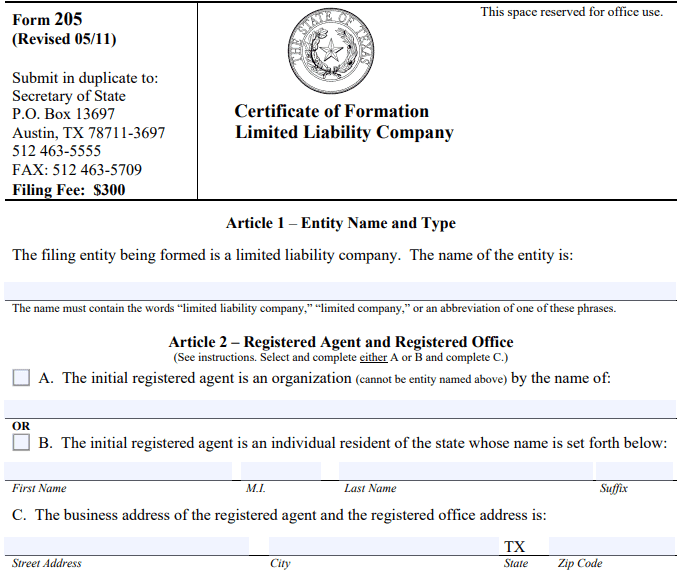
3. Filing of Certificate of Formation
The
Certificate of Formation is required to be filed with the Secretary of State for
registering your Texas LLC, this can be done online or by mail. This will cost you
$300. You will need to mention that whether your LLC will be member managed or
manager managed. In Member managed LLC all members of the LLC manage the company.
This is good for small organizations where everyone is involved in day-to-day operations.
The 2nd option is manager managed, where LLC is managed by individuals
appointed for this purpose. This is appropriate for larger organizations, where
not everyone is involved in the day-to-day affairs of the business. The
certificate must include:
- the LLC’s name, including the chosen LLC
designation - name & address of the registered agent
- will LLC be member managed or manager managed
- in the case of member managed LLC, the name and
address of each initial member - in the case of manager managed LLC, the name and
address of each initial manager - the general-purpose clause
- the name and address of the organizer
- an effective date of the certificate
- the signature of the organizer.
4. Create an operating agreement
Although
not every state requires it, you should always create an operating agreement to
establish ownership terms and member roles for your LLC. These foundational documents
the core of your Land will help you maintain your organizations well as further
establish your Lilacs a separate legal entity. There are 6 main sections of an
operating agreement. The organization outlines when and where the company was created,
who the members are, and how the ownership is structured. Management & voting
addresses how the company is managed as well as how the members vote. Capital
contributions covers which members financially support the LLC and how more funds
will be raised in the future. Distributions outline how the company’s profits
and losses are shared among members. Membership changes describe the process
for adding or removing members as well as if and when members can transfer
their ownership shares. And dissolution, which explains the circumstances in
which the LLC may be dissolved. An operating agreement an internal document.
It does not need to be filed with the state. However, it should be updated
every time there’s a change in membership or management at the company. The
operating agreement should include the following:
- the members’ percentage interests in the LLC
- the members’ rights and responsibilities
- the members’ voting powers
- how profits and losses will be allocated
- rules for holding meetings and taking votes,
and - buyout, or buy-sell, provisions, which determine what happens when a member wants to sell his or her interest,
dies, or becomes disabled.
5. Obtaining an Employer Identification Number (EIN)
After completing all
the above process you will need to get an Employer Identification Number or
EIN, from the IRS. Also known as a Federal Tax Identification Number, your EIN
is like a social security number for your Land is how the IRS tracks your
business for tax purposes. An EIN is also necessary to open a business banking account
and legally hire employees. EIN’s are free of charge and can be obtained from theirsonline or through the mail. And with that, you have formed Texas LLC on your own.
 6. Filing of Annual Report
Keep in mind Texas
LLCs are required to file an annual report and franchise tax together. LLCs
with annual revenue below $1.1 million do not pay any franchise tax, but
must file a no tax due report. LLCs with annual revenue of greater than $1.1
million pay a graduated tax that is calculated based on a complex formula. This
is due by May 15th each year.
The second way to create a Texas LLC is to hire a
professional service to create LLC for you. Hiring a professional service for
filing your forms and act as your registered agent for the LLC will cost you some
additional amount. However, there are several benefits to working with a hired
registered agent it helps in getting your reports filed on time, helps you stay
organized by keeping your business mail separate, and is available at all
regular business hours to accept official mail and legal papers on your LLC’s behalf.
A final and important additional benefit of using a service is privacy. A
professional service will provide a level of privacy by withholding your personal
name and home address from the LLC’s contact information. There are many
reasons you might not want your personal information easily accessible and
associated with your business. Hiring a professional formation service an
easy way to accomplish this.
I hope after
reading this article now you have got a very good idea of what steps are required and
procedure to be followed to set up an LLC in Texas.
How much it cost to set up LLC in Texas ?
- Filing fee of $300 is to be paid to The Texas
Secretary of State, in addition to this an additional state-mandated 2.7%
convenience fee is also required to be paid for filing an LLC Certificate
of Formation. - If you want to reserve your LLC name before filing
the Certificate of Formation, fees of $40 is to be paid to file a name
reservation application.
Frequently
Asked Questions – FAQs
1. What is an LLC and
why should you start one in Texas?
An LLC or Limited
Liability Company is a popular business structure that offers personal
liability protection to its owners or members while providing flexibility in
management and taxation. Starting an LLC in Texas is an excellent way to
protect your personal assets while minimizing your tax liabilities.
2. What are the key benefits
of starting an LLC in Texas?
Starting an LLC in
Texas has several benefits, including personal liability protection, pass-through
taxation, minimal compliance requirements, and a business-friendly regulatory
environment. Additionally, Texas has a low-tax environment, making it an
attractive state for entrepreneurs and small business owners.
3. What are the pre requirements
for starting an LLC in Texas?
For starting an LLC in
Texas, you need to file a certificate of formation with the Texas Secretary of
State with a requisite filing fee. You have to appoint a registered agent with
a physical address in Texas and create an operating agreement outlining your
LLC’s management and ownership structure.
5. How long does it
take to start an LLC in Texas?
It generally takes two
to three weeks for processing the application for starting an LLC in Texas is.
However, depending on the workload of the Texas Secretary of State’s office and
any errors or omissions in your filing, this timeline may vary.
6. Can a non-US
resident form an LLC in Texas?
Yes, anyone can form an
LLC in Texas provided if you have a physical address in Texas and appoint a
registered agent with a physical address in the state.
7. What is Texas LLC
Annual Filing Requirements?
An annual
report & Franchise Tax are to be filed with the Texas
Comptroller of Public Accounts by LLCs in Texas and this can only be done
online at the website of Texas Comptroller. For this purpose you have to
create an online account.
8. Can I form an LLC on
my own or do I need to hire a lawyer?
You can form an LLC on
your own in Texas, but it’s recommended that you hire a lawyer or use an online
formation service to ensure that everything is done correctly. Forming an LLC
involves many legal requirements and it’s important to make sure that all documents
are properly drafted and filed.
9. Do I need to have a
registered agent for my LLC in Texas?
Yes, you need to have a
registered agent for your LLC in Texas. A registered agent is a person or
company that receives legal documents and other official correspondence on
behalf of your LLC. You can be your own registered agent or hire a professional
service to act as your registered agent.
10. What is a Texas
franchise tax and do I need to pay it?
A Texas franchise tax
is a tax on businesses that is based on the amount of revenue they generate.
Most LLCs in Texas are subject to the franchise tax, but there are some
exemptions and deductions that may apply. You should take advise of a tax
professional to determine your specific tax liabilities.
Related Post ;
How To Register a Limited Liability Company (LLC) in USA
mbtTOC();
{“@context”:”https://schema.org”,”@type”:”FAQPage”,”mainEntity”:[{“@type”:”Question”,”name”:”What is an LLC and why should you start one in Texas?”,”acceptedAnswer”:{“@type”:”Answer”,”text”:”An LLC or Limited Liability Company is a popular business structure that offers personal liability protection to its owners or members while providing flexibility in management and taxation. Starting an LLC in Texas is an excellent way to protect your personal assets while minimizing your tax liabilities.”}},{“@type”:”Question”,”name”:”What are the key benefits of starting an LLC in Texas?”,”acceptedAnswer”:{“@type”:”Answer”,”text”:”Starting an LLC in Texas has several benefits, including personal liability protection, pass-through taxation, minimal compliance requirements, and a business-friendly regulatory environment. Additionally, Texas has a low-tax environment, making it an attractive state for entrepreneurs and small business owners.”}},{“@type”:”Question”,”name”:”What are the pre requirements for starting an LLC in Texas?”,”acceptedAnswer”:{“@type”:”Answer”,”text”:”For starting an LLC in Texas, you need to file a certificate of formation with the Texas Secretary of State with a requisite filing fee. You have to appoint a registered agent with a physical address in Texas and create an operating agreement outlining your LLC’s management and ownership structure.”}},{“@type”:”Question”,”name”:”How long does it take to start an LLC in Texas?”,”acceptedAnswer”:{“@type”:”Answer”,”text”:”It generally takes two to three weeks for processing the application for starting an LLC in Texas is. However, depending on the workload of the Texas Secretary of State’s office and any errors or omissions in your filing, this timeline may vary.”}},{“@type”:”Question”,”name”:”Can a non-US resident form an LLC in Texas?”,”acceptedAnswer”:{“@type”:”Answer”,”text”:”Yes, anyone can form an LLC in Texas provided if you have a physical address in Texas and appoint a registered agent with a physical address in the state.”}},{“@type”:”Question”,”name”:”What is Texas LLC Annual Filing Requirements?”,”acceptedAnswer”:{“@type”:”Answer”,”text”:”An annual report & Franchise Tax are to be filed with the Texas Comptroller of Public Accounts by LLCs in Texas and this can only be done online at the website of Texas Comptroller. For this purpose you have to create an online account.”}},{“@type”:”Question”,”name”:”Can I form an LLC on my own or do I need to hire a lawyer?”,”acceptedAnswer”:{“@type”:”Answer”,”text”:”You can form an LLC on your own in Texas, but it’s recommended that you hire a lawyer or use an online formation service to ensure that everything is done correctly. Forming an LLC involves many legal requirements and it’s important to make sure that all documents are properly drafted and filed.”}},{“@type”:”Question”,”name”:”Do I need to have a registered agent for my LLC in Texas?”,”acceptedAnswer”:{“@type”:”Answer”,”text”:”Yes, you need to have a registered agent for your LLC in Texas. A registered agent is a person or company that receives legal documents and other official correspondence on behalf of your LLC. You can be your own registered agent or hire a professional service to act as your registered agent.”}},{“@type”:”Question”,”name”:”What is a Texas franchise tax and do I need to pay it?”,”acceptedAnswer”:{“@type”:”Answer”,”text”:”A Texas franchise tax is a tax on businesses that is based on the amount of revenue they generate. Most LLCs in Texas are subject to the franchise tax, but there are some exemptions and deductions that may apply. You should take advise of a tax professional to determine your specific tax liabilities.”}}]}